

Letters: Bread Cred Redemption
May 24, 2026Welcome to Letters from CAMP, a newsletter on anti-monopoly activity in Canada and abroad, brought to you by the Canadian Anti-Monopoly Project. In this instalment we have:
If you enjoy Letters, please consider sharing and supporting CAMP. Now let’s dive in.
Canadians Get Some Relief as Bread Price-Fixing Settlement Payments LandIn a change of pace, this week some money flowed out of Loblaws and into the pockets of Canadians. Nearly 9 years since the bread price fixing scheme was revealed to the public, payments for Loblaws’ bread price fixing class action settlement have started going out to consumers. A quick recap: in 2017, just before Christmas, Loblaws admitted to participation in a scheme to raise the cost of bread products as much as $1.50 over 15 years. This kicks off two tracks of action, a cartel investigation by the Competition Bureau and several class action suits against the alleged participants. To settle the class action lawsuit, Loblaws and George Weston Ltd. agreed to pay out $500 million to Canadians. This week, the fruits of that suit, a payment of either $24.11 or $49.11, are headed to Canadians who filed a claim. While Canadians should be thankful for the firms bringing these class actions, the restitution pales in comparison to the scope of the harm. Estimates put the per household cost of the scheme at $400 over the course of the conduct. Today the higher end of the payout scores you about 16 loaves of Wonder Bread. Crime shouldn’t pay. U.S. antitrust law contains the concept of treble damages, that the financial penalty of the conduct should be three times the damage caused. With treble damages and direct consumer restitution, Canadians could have seen $1,200 instead of $49 hitting their accounts. This would be a meaningful deterrent to cartel participants and deliver a benefit greater than the federal government’s recent GST rebate at no cost to the taxpayer. After nearly a decade wait, compensation for what Canadians have had to put up with is welcome. But the delay and the amount is a reminder of how much work there is left to be done to break up Canada’s cartel economy. 📰 CAMP in the News 📰
What You Don’t Know Can Hurt YouA new report out this week by Canada’s Public Interest Advocacy Centre (PIAC) examines the relationship between property controls, clauses in commercial leases and titles that affect how land can be used, and competition in the grocery sector. Drawing on domestic and international research, this landmark report explores how these covenants affect consumers and food distribution, and how Canada might deal with them. As the Competition Bureau investigates property controls and Manitoba’s move to void certain property controls, this report is an important contribution to our understanding of how these arrangements shape competition. One finding in particular: PIAC notes that comprehensive data about property controls and restrictive covenants in Canada simply doesn’t exist. These terms are often tucked away in private leases, which makes finding them difficult and costly for researchers or members of the public. Without comprehensive data about what properties are governed by these covenants, Canadians are in the dark on the extent to which competition could be muted by them. Just one example of how this data could help policy makers and Canadians, mapping property controls against food deserts could reveal their role in denying people access to fresh and healthy food and pave the way for addressing the issue. Like the bread price fixing scandal, much of the worst of monopolies occurs behind closed doors. PIAC’s research identifies crucial data gaps that put consumers, researchers, and policy makers at a disadvantage to major grocers and commercial landlords who often have overlapping roles. Answering PIAC’s calls for a national registry and database of property controls would be an excellent start and would be well matched by the Bureau by ratcheting up the legal tests for the legitimacy of existing property controls. 📚 What We’re Reading 📚
To the Model Owners Go the SpoilsIn the market for foundation AI models, the models on top of which companies build AI applications, three dominant firms have emerged: Anthropic, OpenAI, and Google. This week, Asad Ramzanali and Tom Wheeler write for Brookings that regulators must act now to ensure that this dominance is not allowed to expand into the market for those same applications. As we say in the monopoly space, everything is railroad. As the models these companies develop become infrastructure for a growing number of businesses, we need to pay attention to what they do with control over the tracks. Much of innovation in the AI application space takes the form of wrappers, services that tailor and constrain queries to foundation models to produce specific results in specific environments. This isn’t a bad thing. Training foundation models costs billions to develop and maintain, and companies provide real value by tailoring functions to specific workflows and user needs. If the advertised widespread productivity increases associated with AI are going to be realized, firms creating these services for specific applications will be doing the heavy lifting. The problem, as Ramzanali and Wheeler point out, is that model owners are competing in this application layer as well. This gives them the ability to tilt the playing field in their favour or unfairly exclude potential competitors from access to their models entirely. When your biggest competitor can control access to a critical input to your business, you’re on the wrong side of a monopoly. The fix? Ramzanali and Wheeler say foundation model providers should be barred from unjust discrimination in pricing, speed, or the quality of service they provide competitors. With fairness and neutrality as a guiding principle, we can ensure foundation dominance isn’t allowed to crowd out innovation at the application layer. If you have any monopoly tips or stories you'd like to share, drop us a line at hello@antimonopoly.ca
|



Letters: Let's Make a Deal
May 17, 2026Welcome to Letters from CAMP, a newsletter on anti-monopoly activity in Canada and abroad, brought to you by the Canadian Anti-Monopoly Project. In this instalment we have:
If you enjoy Letters, please consider sharing and supporting CAMP. Now let’s dive in.
Digital Trade is Not Fair TradeAs negotiators from Canada, the U.S. and Mexico gather this summer for the six-year review of CUSMA, many Canadians are understandably worried about the future of the agreement. The deal, particularly its rules on tariff-free trade in goods, has sheltered Canada from a degree of the trade turmoil that the U.S. has thrown the world. But while much of the headlines and policy discussion on CUSMA have focused on the movement of physical goods, buried in the agreement are important rules restricting the freedom of countries to operate in the digital realm. In a new brief, CAMP lays out how CUSMA’s chapter on Digital Trade was turned into a Trojan Horse for Big Tech’s policy agenda, restricting the ability of all signatory countries, not just Canada, in reining in the excesses of digital giants. Articles on non-discrimination allow the largest companies on the planet to claim unfair treatment. Data and facilities localization rules limit the ability of countries to have a say over where their citizens data goes. The rules even attempt to import the U.S.’s blanket liability shield for content hosted on digital platforms. Whether you care about competition, online harms, or privacy, CUSMA’s digital trade rules represent a hurdle to tackling these important issues. Though we may feel on the back foot, Canada should not discount the hand we have in this or any future CUSMA negotiations. While Canada-U.S. relations are strained, we should not forget that we have common cause here with American and Mexican citizens and policymakers who want to defend the public interest in the digital realm. Other great Canadian organizations like Open Media and the Canadian SHIELD Institute have championed Canada pushing back on Big Tech’s trade policy agenda. More than just holding on for dear life, all signatories of the deal should take this review as an opportunity to reclaim control of our digital lives. 📰 CAMP in the News 📰
The Private Equity Bomb Under Canada’s EconomyThere’s been a long overdue conversation about foreign direct investment happening in Canada. Foreign direct investment numbers are breathlessly reported as a signal of whether Canada is attractive for global capital, completely ignoring what that capital is being used for. Instead of the idyllic view of capital from abroad building up Canada’s productive capacity, the reality is that a third of these flows have been going to the takeover and consolidation of Canadian businesses. In that same period, the role of foreign private equity firms in this acquisitive behaviour has grown dramatically. Setting aside real concerns about Canada’s control of vital assets and productivity, this week Canada received a reality check that this global private equity cash is also making our economy vulnerable to negative shocks. In a new brief, ratings agency Moody’s shows that the growing prominence of private equity ownership is driving up the credit risk for speculative grade companies, whose debt is labeled with the unfortunate moniker of ‘junk bonds.’ In English, private equity is making these companies an even riskier bet, more vulnerable to future negative economic shocks. Why is this the case? In 2024, CAMP fellow Rachel Wasserman warned that the growing role of buyout private equity was hollowing out rather than building up Canadian businesses. By funding acquisitions through debt foisted onto the acquired company, engaging in leasebacks that burden companies with renting assets they previously owned, and forcing companies to issue dividends they can’t afford, private equity ownership makes companies more brittle and less able to adapt. We like being ahead of the curve, but this is one area where we’d prefer to be wrong rather than prescient. Moody’s warning makes it clear: without reining in these extractive practices, Canada’s economy will be less able to weather the next wave of economic turmoil. 📚 What We’re Reading 📚
California Gets Serious on Consumer ProtectionU.S. states like California and New York are stepping up to the plate for consumers, passing new laws and beefing up their regulators to oppose corporate power. They’re going after surveillance pricing, junk fees, and even Ticketmaster. While the federal government retreats, states in the U.S. are picking up the slack from the moribund FTC and Consumer Financial Protection Bureau (CFPB), dismantled by an administration whose love of deals is putting the interests of consumers dead last. This trend continued this week with California Governor Gavin Newsom announcing the appointment of Rohit Chopra, previous head of the CFPB and longtime anti-monopoly champion, to helm the state’s new consumer protection agency. He’s taken on everyone from banks to Big Tech and worked tireless as both a regulator and consumer advocate. The clearest signal he was effective challenge to corporate power in his role as head of the CFPB? He was fired immediately when the Trump Administration rolled into town. Canada has a lot to learn from the actions taken by the states down south. While the federal government owns the competition file, the provinces have a wide range of powers related to consumer protection and unfair business practices. While thankfully Canada is not experiencing the same federal retreat from competition, there’s still an important role for provinces to play in creating fair markets in Canada. As Canadians continue to struggle with the consequences of the monopolies around us, our provincial governments should be looking south for inspiration. If you have any monopoly tips or stories you'd like to share, drop us a line at hello@antimonopoly.ca
|

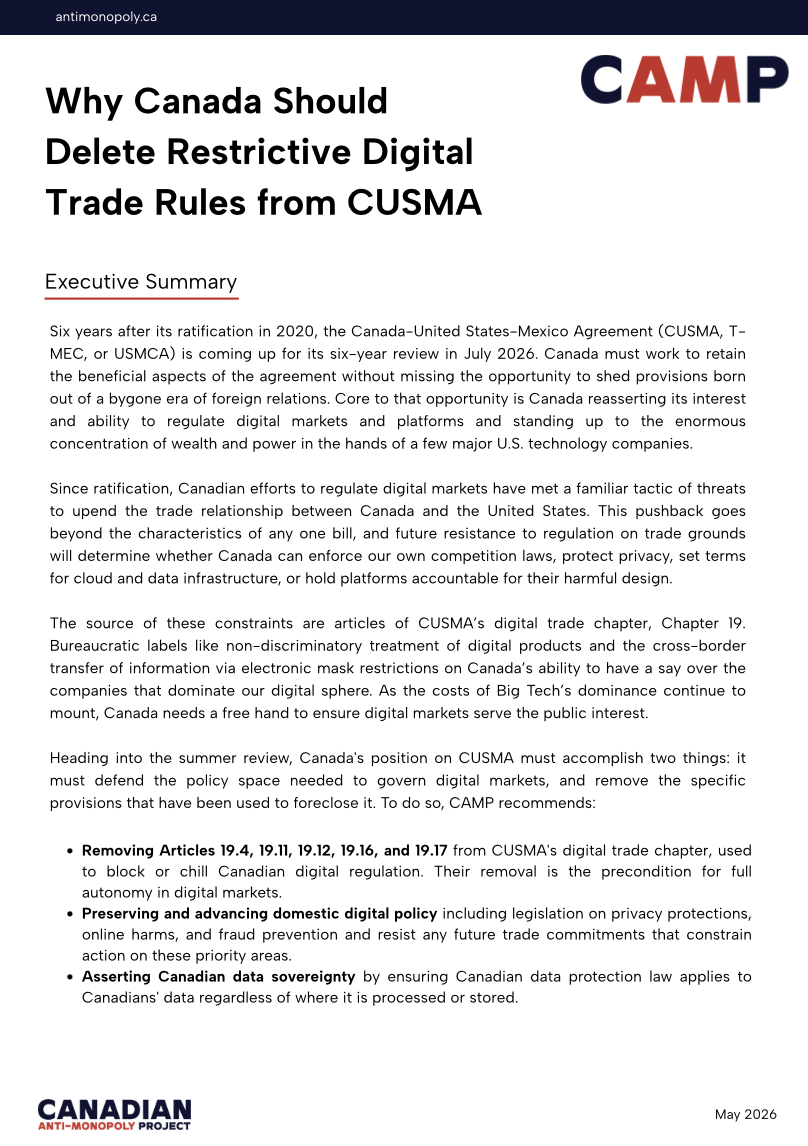
Why Canada Should Delete Restrictive Digital Trade Rules from CUSMA
While the upcoming review of CUSMA, the trade agreement between Canada, the United States, and Mexico, has dominated headlines, the debate has focused almost entirely on tariffs and the trade of physical goods. Canadians need to know that there’s more at stake beneath those headlines.
Buried in the agreement are five articles in Chapter 19, the agreements chapter on digital trade rules, that limit Canada’s ability to regulate Big Tech. Covering non-discrimination, data flows, computing infrastructure, source code, and platform liability, these provisions have already been used to block or chill Canadian digital regulation. With the review underway this July, Canada has the opportunity to change that while keeping in place the beneficial elements of the deal in place.
To do so, Canada should:
- Remove Articles 19.4, 19.11, 19.12, 19.16, and 19.17 from CUSMA’s digital trade chapter, used to block or chill Canadian digital regulation. Their removal is the precondition for full autonomy in digital markets.
- Preserve and advance domestic digital policy including legislation on privacy protections, online harms, and fraud prevention and resist any trade future commitments that would constrain these areas going forward.
- Assert Canadian data sovereignty by ensuring Canadian data protection law applies to Canadians’ data regardless of where it is processed or stored.
Canada can benefit from expanding trade without sacrificing our freedom of movement in the digital sphere. From competition to privacy to online harms, these rules represent a hurdle to tackling the very real challenges in digital markets.

This Ontario man bought the same car as his wife and has a flawless driving record. Why is his insurance $649 more?
Toronto Star
Speaking to the issue of surveillance pricing, CAMP fellow Andrew Paulley talks to the Toronto Star about how insurance companies use their data advantage to charge different prices to the same kinds of consumers.
“There are some companies that charge more for men than they charge for women and the difference is larger than average,” Paulley says. “So really, you could get 20 quotes, and the gap between the lowest and the highest for the exact same amount of insurance for this one male driver that you’re speaking of, could be upwards of $2,000.”

Letters: Gassed Up
May 10, 2026Welcome to Letters from CAMP, a newsletter on anti-monopoly activity in Canada and abroad, brought to you by the Canadian Anti-Monopoly Project. In this instalment we have:
If you enjoy Letters, please consider sharing and supporting CAMP. Now let’s dive in.
Concentration in CondensationThis week, the Competition Bureau filed its review of a proposed merger between two of the largest players in the market for natural gas refinement in Fort Saskatchewan, just outside of Edmonton, Alberta. Three players, Keyera, Plains, and Pembina, control 80-90% of production at the Hub, and Keyera has its sights on the assets of Plains. While it’s not a market most Canadians think about daily, it’s a market where competition is important not just for players within the industry but for consumers downstream as well. The operations of these companies are large, capital-intensive, and vertically integrated. The Bureau’s review focuses on two parts of the process: fractionation, the separating of natural gas liquids into different products, including condensate, a critical input for the broader oil sands, and cavern storage. Geography matters: the market is defined where infrastructure exists and who hooks into it. The Bureau’s analysis suggests a merger between Keyera and Plains would result in an effective monopoly for producers who are not connected or compatible with the remaining competitor at the Hub. This merger challenge is a test of Canada’s reformed competition laws which take a much harsher view of increases in market concentration. Before reforms, Canada’s laws allowed for mergers to literal monopoly. Reforms changed that, and we’re keen to see the Bureau attempt to stop this kind of extreme concentration. This kind of control could allow the merged entity to set terms for producers, raise prices for buyers, and exercise long term control over a critical piece of Canada’s petroleum infrastructure. While not a market likely to make headlines, this challenge will be an early signal of whether Canada’s new competition laws are up to the task. 📰 CAMP in the News 📰
Location, Location, LocationWhen we think about competition in grocery, we often think about comparing the price and variety of different products across stores. But that kind of competition is determined by what stores are close enough for you even to consider visiting, and that is determined by competition in commercial real estate. This week, in the Globe and Mail, CAMP fellow Rachel Wasserman and CAMP executive director Keldon Bester lay out how a proposed commercial real estate acquisition could give Loblaws the upper hand in this important market. First Capital, a real estate investment trust or REIT, is in trouble and looking to sell off its portfolio of commercial real estate. The buyers coming to save the day are Choice Properties and KingSett Capital, offering a combined $9.4 billion for a mix of high street retail and grocery stores and shopping centers. Choice Properties, primarily interested in the larger format assets, is majority owned and controlled by the Weston family, the owners of Loblaws. Already a major player in commercial real estate, this transaction would further cement Loblaws’ control over an important dimension of grocery competition in Canada. We’re becoming a bit of a broken record on grocery real estate. But unlike the property controls that we recently covered, this transaction is an extension of control via acquisition rather than contract. The deal would see at least 50 leases from Loblaws competitors transfer to Choice, bringing them within the broader Weston umbrella. At a time when Canadians want more variety in grocery stores, this deal would further tip the scales towards an already dominant incumbent. The Competition Bureau has correctly noted that we need more competition in grocery. Stepping in to challenge this transaction would be an important signal that they mean what they say. 📚 What We’re Reading 📚
When You Can’t Bank on the BanksCanada is doing some economic soul-searching these days. We want to diversify trade and stimulate competition, but each year fewer businesses are created and productivity growth continues to stall. Just when we need new businesses, private equity firms flush with cash are rolling up fragmented markets, taking advantage of a succession crisis rippling across Canadian small businesses. A new report out from Social Capital Partners this week explains one important driver of this cycle: Canada’s banks are not set up to serve the businesses, both small and large, that Canada needs to be growing. The figures are stark. Small and medium-sized businesses represent only 11.5% of outstanding loans, a quarter of the 44% OECD average. The problem is that our banks effectively have the same playbook: either big, safe bets with large enterprises and profitable mortgage products for the rest of us. A core function of a bank is to allocate capital to start and grow businesses, produce new things, and create value for Canadians. They can’t do that when they’re constantly looking over each other’s shoulder. Our financial sector regulator is starting to recognize this and is now piloting an approach that would bring different kinds of banks into the market. But the folks at Social Capital Partners point out that more banks alone are not enough to get the job done. If Canada wants growth to be widely available, it needs to increase and diversify access to capital. Some enterprises have priorities that will never make sense to a bank. Non-profits, cooperatives, and purpose-driven organizations are structurally excluded from accessing capital. With Canada’s highly educated workforce, these non-typical enterprises could deliver real value to the economy, but only when new doors to capital are open for them. Diversifying access to capital, inside and outside the banking sector, is a key ingredient in the push to diversify our economy. If you have any monopoly tips or stories you'd like to share, drop us a line at hello@antimonopoly.ca
|