Letters: Safety First
June 14, 2026Welcome to Letters from CAMP, a newsletter on anti-monopoly activity in Canada and abroad, brought to you by the Canadian Anti-Monopoly Project . In this installment we have:
If you enjoy Letters, please consider sharing and supporting CAMP. Now let’s dive in.
Farm to Table CompetitionThis week, the federal government announced a National Food Security Strategy with a goal of increasing both affordability and resilience in Canada’s food system. The strategy identifies market concentration as a major issue driving up prices for consumers, and puts competition front and centre, motivating big investments into increasing domestic infrastructure, industry, and even consumer protections. Importantly, the strategy goes well beyond the grocery sector itself, with funding directed to farming, food processing and distribution. $1 billion will go to scaling Canadian capacities for food processing, giving farmers more options to sell their produce and promoting competition in a deeply consolidated market. Another $1 billion into food hubs and public food terminals will provide wholesale options for independent grocers across Canada, making it easier and cheaper to operate. The Competition Bureau’s funding will be increased after cuts earlier this year, earmarked to go after anticompetitive practices and abuse of dominance in the food system, and conduct a major market study on Canada’s food system. Alongside these big-ticket items are several more nods to important issues that readers will be familiar with. Property controls make an appearance, but the role of commercial real-estate consolidation and prices isn’t considered. Surveillance pricing gets a mention — right alongside a commitment to PIPEDA modernization that has yet to materialize. There’s no mention of merger controls, sadly, which will be essential to ensure returns on these competition investments aren’t swallowed up by incumbents. But even so, the National Food Security Strategy marks an ambitious step towards addressing the structural issues at play in Canada’s food system. 📰 CAMP in the News 📰
Digital Safety ReduxIn another big regulatory move this week, the federal government also proposed its Digital Safety Act or Safe Social Media Act (SSMA). A successor to the Online Harms Act, the SSMA aims to regulate social media, online platforms, and even AI chatbots to make sure the products are effectively moderated, and that the companies operating these products are held to verifiable and enforceable standards. Canada’s policymakers have had the opportunity to learn from other jurisdictions’ attempts at social media regulation, which some argue, makes the legislation stronger. Specifics, including which services will be included and how standards will be set, evaluated and enforced, aren’t yet clear. It will be up to the newly created Digital Safety Commission and its leadership to make those decisions. That Commission will have a lot of power, not only to set standards, but to make sure companies are doing their duty. Many are talking about age restrictions on social media, and rightfully so. The SSMA does restrict social media for people under the age of 16, but only conditionally — if operators can prove they’re safe for kids, then there’s still room for all-ages platforms. Notable provisions also include monetary penalties, requirements to take down harmful content, and carve-outs for accredited researchers to use data from platforms to do public interest research. This is an important and needed piece of legislation that addresses the role of online platforms in our society and imposes duties not only to proactively protect vulnerable users, but to account for their actions to regulators and the public. The government should use a similar formula for the forthcoming anti-scam strategy. Empowering regulators and researchers to understand social media feeds, and imposing duties on platform operators is a good start, but the new Commission will have an uphill battle against some serious opponents like Meta and will need to be able to show its teeth. $20 million fines aren’t going to cut it. 📚 What We’re Reading 📚
Surveillance Pricing and the End of the DealThe use of personal data to set prices for consumers, often called algorithmic or surveillance pricing, is not popular in Canada. 52% of Canadian respondents want it banned, and 31% would only accept it if strongly regulated. Not to be upstaged by opposition leaders calling for a ban, the governing Liberals have been inserting subtle mentions to the practice; in their AI strategy, and now in their food strategy. In a new piece, CAMP fellow Andrew Paulley makes the case that intervention is needed now, before the scales are tilted too far against the consumer and in favour of the corporation. In the most extreme forms of surveillance pricing the base price of an item all but disappears, and each shopper sees only a price that is generated based on their context and data, possibly served to them by an AI agent. If pricing is totally individualized and the consumer always pays the highest possible price, the notion of a discount or a deal evaporates. Consumers will have no idea how to determine if they’re paying a good price, but these kinds of practices and systems are designed to be opaque, and their effects can be hard to track. Last week, the government also gutted funding for consumer protection research in civil society, which will make finding effective ways of tracking and calling out surveillance pricing even harder. The government needs to act now, rather than waiting for this to become a more serious problem, as the Bureau did last year when its consultation into algorithmic pricing ended with a shrug. From a regulatory perspective, updating privacy regulations is a good starting point, which is exactly what the government has floated in the National Food Security Strategy. These regulations must cover the kinds of data that can be collected about Canadians, and how it can be used — including how it can be synthesized and sold. If companies are going to offer or use services for price setting, those algorithms must be available to regulators, due to the possibilities for collusion and price gouging. If you have any monopoly tips or stories you’d like to share, drop us a line at hello@antimonopoly.ca
|


National Food Security Strategy puts competition front and center
June 12 2026 [Ottawa, ON] – This week the federal government released its National Food Security Strategy, with the goal of building a stronger and more affordable Canadian food system. Core to the strategy are measures to support more competition in food distribution, processing, and production, as well as resources for the enforcement of Canada’s competition laws. Highlights of the strategy from a competition perspective include:
- $1 billion for a food infrastructure fund to help independent grocers get products on their shelves without going through their biggest competitors
- $130 million for the Competition Bureau and Competition Tribunal to investigate anti-competitive conduct in the food system
- $1 billion in funding for Farm Credit Canada to support more competition in food processing
“The pairing of investment in alternative market infrastructure and resources to protect fair competition are a powerful combination,” said Keldon Bester, executive director of CAMP. “Today, too many independent entrepreneurs in the food system are dependent on their own competitors for the things that make their own businesses possible. Creating alternatives to these consolidated markets is key to unlocking competition in the grocery sector. We’ve been saying for years that the conversation about competition in grocery has to go deeper than the store shelves. We’re glad to see this strategy recognize that reality.”
There’s more work to be done the provincial and federal levels: banning property controls, reining in algorithmic pricing, and breaking open monopolies further up the supply chain. But the National Food Security Strategy has the structural causes of high grocery prices, not just the symptoms, in its sights.
Canada’s grocery market has been broken for a long time, but this is an important step towards fixing it.
Letters: Parting Clouds
June 7, 2026Welcome to Letters from CAMP, a newsletter on anti-monopoly activity in Canada and abroad, brought to you by the Canadian Anti-Monopoly Project. In this instalment we have:
If you enjoy Letters, please consider sharing and supporting CAMP. Now let’s dive in.
New CAMP Report Shines a Light on the Cloud Computing Oligopoly and What to Do About ItNot so long ago, businesses and governments would maintain their own IT infrastructure, keeping physical banks of servers and hardware on their own premises. Today, the landscape looks dramatically different. Cloud computing, the outsourcing of computing infrastructure to specialized providers, is now the predominant IT backbone of business and government for all but the most sensitive data. This phenomenon is only set to intensify as AI supercharges demand for flexible and large-scale computing workloads. The only problem? The current cloud computing market is three American companies in a trench coat. In our new report, Parting Clouds, CAMP tackles head on the issue of a concentrated cloud computing market. Businesses and governments depend on these services to function smoothly. But the concentration of this market has created economic and geopolitical vulnerabilities. Countries are now reconsidering the arrangement that put massive economic infrastructure in the hands of companies headquartered in an increasingly erratic country. But breaking out is no simple task. The scale and flexibility of U.S. cloud computing companies cannot easily be matched, and clients looking to leave face a wall of lock-in, opaque contracts, and predatory deals To make competition work in the market for cloud computing, Canadian policy makers need to put interoperability at the heart of their procurement, regulatory, and competition law enforcement actions. Rather than trying to force alternatives into existence, Canada, along with other middle power and unaligned nations, can create the conditions for challengers to the cloud oligopoly to emerge and thrive. The timing couldn’t be more apt: dependable and accessible compute is a cornerstone of the federal government’s recently released AI for All strategy. By working with allies to create a more competitive cloud market, Canada can reinforce the digital foundation of our economy in an increasingly volatile world. 📰 CAMP in the News 📰
Online Advertising Data Puts Members of the Military at RiskThe design of the modern online advertising market means that for a nominal fee, anyone can construct a highly detailed picture of an individual, including their near real-time location. For the average person, this is at best a creepy realization. But for individuals working in high security fields like the military, the potential for danger is much higher. This week, Reuters reported on a letter from Senator Ron Wyden detailing that U.S. military personnel were being tracked and targeted using this very data by adversaries of the U.S.. This risk is not new to policy makers. Civil society organizations, including CAMP , have pointed out that nearly every individual is vulnerable to abuse flowing from the persistent commercial surveillance system we built up around ourselves. Without proper privacy laws, precise location data is both a massive privacy issue and a threat to national security. While recent reporting focuses on U.S. soldiers, there’s nothing stopping an adversary from engaging in the same conduct against members of the Canadian armed forces or security establishment. While vendors often claim data is properly anonymized, as soon as patterns of behaviour can be tied to location it is trivial to identify an individual and find out where they live, work, and relax. This task becomes even easier as AI brings down the cost and complexity of synthesizing large volumes data. While militaries may attempt to lock down government devices, the problem will persist so long as this information is commercially available. Canada and our allies need robust privacy laws that ban the collection and use of this data if we want to keep safe those who face the highest risk. 📚 What We’re Reading 📚
Avoiding a Capital MonopolyLate last month it was announced that TMX, Canada’s largest stock exchange operator, proposed to acquire Cboe’s equities exchanges in Australia and Canada. The takeover is being pitched by the purchaser as a chance to offer Canadian companies simplicity and greater reach into capital markets. But in a piece for the Globe this week, University of Calgary Business School Associate Dean Ari Pandes lays out how the acquisition could mean less competition, higher prices, and worse service in an important channel of capital. After the deal, Canada would have a single exchange operator with over 90% of the listing market, putting the transaction well into the danger zone of Canada’s newly strengthened merger laws. As Pandes argues, the transaction would be a step backwards as we try to make our economy more competitive, productive, and appealing as a market for companies to grow. To preserve competition in the market that determines whether challengers can emerge across the economy, the Competition Bureau must act decisively and block TMX’s acquisition of Cboe’s Canadian operations. If you have any monopoly tips or stories you'd like to share, drop us a line at hello@antimonopoly.ca
|

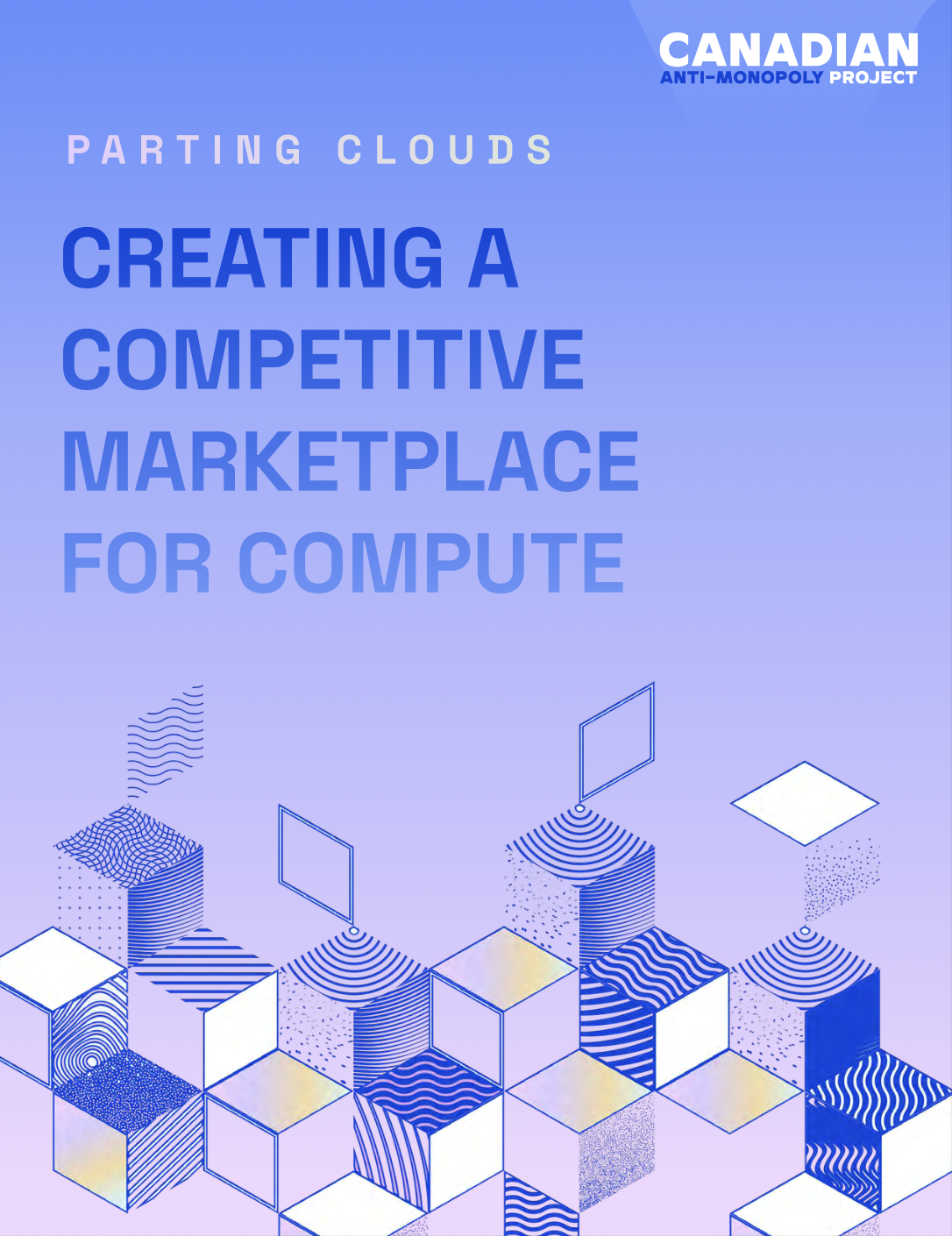
Parting Clouds: Creating a Competitive Marketplace for Compute
Three American firms — Amazon, Microsoft, and Alphabet — control 85% of Canada’s public cloud market. The federal government alone spent over $156 million on cloud services in 2022–23, the majority of it flowing to Microsoft and Amazon. For Canadian businesses, from early-stage startups to the country’s largest enterprises, there are no practical alternatives.
That concentration is a competition problem. Vendor lock-in through proprietary technologies, opaque and complex billing, bundling and tying, and the foreclosure of adjacent markets, including the evolving market for artificial intelligence, are predictable consequences of this oligopoly market. But Canada’s dependence on a handful of US hyperscalers represents a risk to sovereignty as well as competition. A country locked into a small number of providers lacks meaningful choice, whether the threat is coercion by a foreign government or rent extraction by an uncontested monopolist.
In a new report, CAMP argues that the most effective response is commoditization: making cloud infrastructure a fungible resource where interoperability standards allow workloads to move freely between providers. The metric for success is not who owns the infrastructure but whether customers can make competition work for them.
To create a competitive marketplace for compute, policymakers should:
- Require interoperability and portability certifications in all federal cloud procurement, ratifying dominant de facto standards rather than inventing new ones
- Attach binding interoperability conditions to any domestic cloud investment programs, to avoid entrenching new domestic monopolies
- Coordinate with like-minded middle powers to align procurement standards and create demand-side pressure no single country can generate alone
- Eliminate egress fees, ban self-preferencing and discriminatory bundling, and treat cloud computing as utility-like infrastructure subject to neutrality rules
- Designate a dedicated industry regulator with the technical capacity to monitor and enforce conduct and standards requirements
- Direct the Competition Bureau to launch a cloud market study and open enforcement proceedings targeting bundling, tying, predatory cloud credits, and discriminatory licensing
- Prioritize removal of CUSMA’s constraints on digital market regulation in Canada’s 2026 renegotiations
Letters: Grocery Guide
May 31, 2026Welcome to Letters from CAMP, a newsletter on anti-monopoly activity in Canada and abroad, brought to you by the Canadian Anti-Monopoly Project. In this instalment we have:
If you enjoy Letters, please consider sharing and supporting CAMP. Now let’s dive in.
CAMP Releases Guide for a Grocery Golden AgeWe talk a lot about groceries at CAMP. We’ve written reports and op-eds, given interviews, and even done a podcast or two. But taking all that in takes time, time most people don’t have. That’s why this week CAMP released our Grocery Guide, a short and digestible summary of what we think policymakers should be doing to make a grocery market that actually serves Canadians. Action couldn’t come sooner: one in four Canadians now experience food insecurity and prices are still on the rise. Canadians are stepping up to help one another out, including the folks at SAVR who have built an app to help you find the lowest grocery prices in your area. But those important individual efforts need to be matched with system-level change that delivers benefits to Canadians. Consolidated incumbents use their power to lock new entrants out of the market with practices like property controls, exclusivity arrangements, and kickbacks for access to shelf space. As algorithmic pricing takes off, shoppers will be less able to engage in the comparison shopping that allows us to save a buck or two every trip. Unwinding and preventing these harmful practices is key to a fairer future for Canada’s grocery market. There isn’t one weird trick, and there isn’t one person or institution who can solve this problem on their own. That’s why the Grocery Guide includes a comprehensive set of ideas for federal, provincial, and even municipal governments to run with. Provinces like Manitoba and cities like Toronto are already charging ahead, and we want to make it as easy as possible for other governments to follow their lead. Canadians deserve a fair and competitive grocery market, and we’ve got the recipe. 📰 CAMP in the News 📰
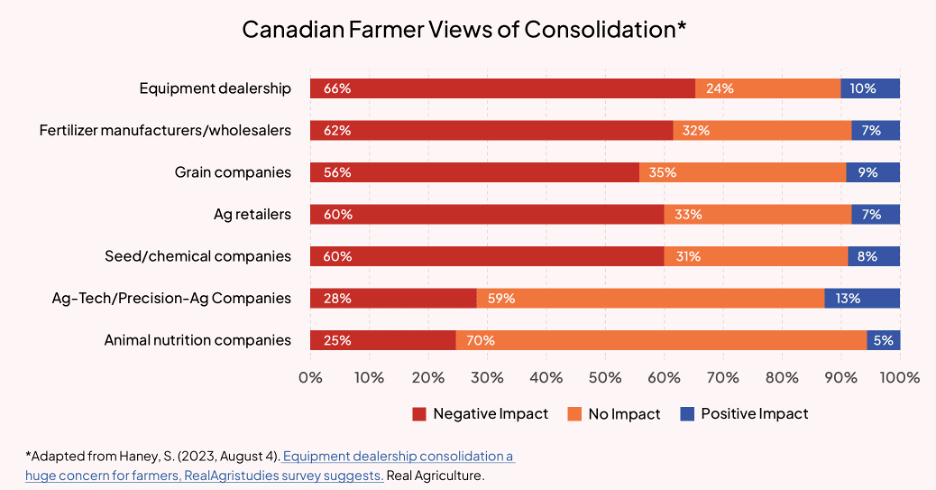
Farmers and Consumers Can Be Anti-Monopoly AlliesLetters readers know that the monopoly issues in our food system extend far beyond the grocery aisle and far beyond our borders. These days, Americans share the same anxiety as Canadians as our totals at checkout creep ever higher. Writing in the New York Times this week, Open Markets’ Claire Kelloway and Sandeep Vaheesan call for anti-monopoly action across the food system to relieve pressure on both consumers and producers. As external shocks ripple through our economy, Kelloway and Vaheesan document how the companies that have consolidated these markets are set to use that volatility to justify higher costs for farmers and consumers alike. Competition in the food system is often viewed as a zero-sum game between consumers and farmers: consumers want the lowest prices while farmers want higher prices for their products. But farmers are victims of the same consequences of consolidation. In the U.S. and Canada, decades of consolidation in meat processing, bread-making and packaged foods have created an environment where price-fixing and gouging can flourish. As CAMP covered in our report Plow to Pantry back in 2024, most farmers understand that this consolidation is harmful to their businesses.
From Plow to Pantry: Monopoly in the Canadian Food System (2024) In their piece, Kelloway and Vaheesan argue that by tackling the practices and structures in these concentrated industries, both farmers and consumers can be made better off. In Canada at least, authorities appear to be listening. Just this week, two Manitoba John Deere equipment dealerships abandoned a proposed merger amid Competition Bureau scrutiny. Last week the Bureau forced the spin-off of a Saskatchewan grain elevator to preserve competition in the grain-handling market. An anti-monopoly approach is the only way to deliver higher prices at the farmgate and lower prices at the checkout. 📚 What We’re Reading 📚
California’s Antitrust Agenda AdvancesCalifornia is one step closer to a major victory in competition and consumer protection law, with the COMPETE Act passing its vote in the Assembly and moving on to the state Senate. The COMPETE Act would reform California’s antitrust law and give state authorities the power to go after individual monopolies rather than having to rely on federal courts and regulators. As CAMP has covered, state antitrust action is increasingly important as federal authorities effectively abandon their posts under the Trump Administration. The COMPETE Act would close a key loophole in California’s antitrust law, the Cartwright Act, that exempts illegal monopolization by a single firm from state enforcement. As our colleagues at the American Economic Liberties Project point out, this loophole has stymied the ability of California’s powerful Attorney General to protect consumers and small businesses. Recently, this allowed Amazon’s practice of pressuring of third-party sellers to raise prices on non-Amazon platforms to escape state enforcement. Bringing California’s antitrust laws up to speed would be a major upgrade in the global fight against monopoly. And this isn’t the only anti-monopoly fight occurring in the Golden State. Now that the U.S. DOJ has given the green light to the hugely damaging Paramount-Warner Bros. merger, all eyes are on whether the state Attorney General will step in to block the takeover in defense of consumers, workers, and filmmakers in California and around the world. Subnational actors like U.S. states and Canadian provinces are reminding us that the anti-monopoly fight must be waged on many fronts. If you have any monopoly tips or stories you'd like to share, drop us a line at hello@antimonopoly.ca
|
The Grocery Guide: A Recipe for a More Competitive Grocery Market
Four years into Canada’s cost-of-living crisis, grocery bills are still climbing and the fallout from global disruptions promise more of the same. But how the cost of these economic shocks land on Canadians depends on the structure of domestic markets.
Canada’s grocery market is dominated by three domestic chains and two American giants, holding roughly 80% of national market share. Discount brands that should be competing are instead flanker brands of the major grocers. Decades of consolidation have removed choice from the market and practices that lock in the power of incumbents like property controls and exclusivity arrangements remain largely unchecked.
It doesn’t have to stay this way.
In our new brief, CAMP lays out a policy roadmap for more grocery competition in Canada. Federally, it means focusing the efforts of the Competition Bureau, ensuring customers can trust what they see on the shelf, and investing in alternative food system infrastructure. Provincially, it means banning property controls and relaxing zoning rules, rolling back exclusivity arrangements and supply chain kickbacks, and prohibiting opaque personalized pricing on staple goods.
New entrants, domestic or foreign, private or public, can help. But they’re no substitute for opening up competition in grocery across the country.