

CAMP Opening Statement to the House Standing Committee on Industry and Technology (INDU) on its Study of Bill C-352
Thank you to the committee for inviting me to speak with you today.
My name is Keldon Bester and I’m the Executive Director of CAMP, a think tank dedicated to addressing the harms caused by monopoly and to building a more democratic economy in Canada. We appreciate the opportunity to appear before this committee to discuss the proposed amendments to Canada’s competition law contained in C-352.
After nearly four decades of pro-consolidation law, Canada is turning the corner on competition policy. With the passage of C-56 late last year, and C-59 being studied in the Senate, this government and in fact all parties have made much-needed improvements to Canada’s competition law. Canada is now on track to have a tougher stance against harmful takeovers, abuses of corporate power, and practices designed to deceive consumers.
But these changes should be understood as the first step in rebalancing the relationship between dominant corporations and Canadian consumers, workers and entrepreneurs. The work of improving competition in Canada is just beginning.
As important as strong laws are, just as important is the effective execution of those laws to the benefits of Canadians. The Competition Bureau is putting the powers gained through C-56 to work in investigating the use of property controls to harm competition in the grocery sector. Along with the recently opened market study into Canada’s airlines, the investigation is an early sign that the Competition Bureau understands that its efforts need to be focused where competition matters most to Canadians.
These efforts raise an important point for future of Canada’s competition law - the need for the quick resolution of competition issues and greater transparency into the work of the Competition Bureau.
Our strengthened laws cannot help Canadians unless they can quickly address practices that harm competition. Today, competition law investigations are a multi-year process. The ongoing investigation into Google’s practices in the digital advertising market has been expanded after four years of investigation, with no timeline for the conclusion of this expanded investigation. While the update is welcome, for news organizations dependent on a competitive advertising market, another four years is likely too late.
When investigations become litigation, Canadians can expect to wait another three to seven years for resolution of practices harming competition. If property controls are indeed weakening competition in the grocery sector, Canadians should not have to wait up to a decade for more competition in such a critical market.
Accordingly, the committee should consider ways in which the investigation and litigation processes could be reformed to speed up the resolution of competition cases.
One step would be to improve the information gathering powers of the Competition Bureau, with powers akin to those of the Office of the Privacy Commissioner and other international competition authorities. If an investigation leads to litigation, the ability to stop parties from engaging in potentially problematic conduct while the litigation is ongoing should be strengthened. Finally, to ensure speedy resolution of cases either way, the litigation process should be streamlined and the future role of the Competition Tribunal should be a topic of study.
Along with more rapid resolution of competition issues, Canadians also deserve greater transparency into the activities of a now strengthened Competition Bureau. Balancing the needs of confidentiality and accountability, Canadians should not be left in the dark on the investigations the Competition Bureau is currently engaged in.
A positive step in this direction would be to repeal language in the Competition Act that requires investigations to be conducted in private, which currently introduces ambiguity with the Competition Act’s existing confidentiality requirements. While this would still leave transparency in the hands of the Competition Bureau, it would be a clear signal of a desire for greater transparency and a first step towards a Competition Bureau that is more open with Canadians.
The work of this committee has resulted in a competition law better equipped to protect Canadians from abuses of concentrated corporate power. A necessary next step is to improve the systems responsible for executing that law.
Thank you for your time and I look forward to your questions.


McKinsey contracts, Islamophobia and NDP leader’s backbench bid to strengthen competition tribunal on the agenda
iPolitics
Industry and technology members go over the fine print of New Democrat Leader Jagmeet Singh’s backbench bid to boost the power of the federal competition bureau and tribunal to investigate — and, in some cases, intervene in — allegations of price-fixing and other “anti-competitive activities,” particularly, although not exclusively, those involving the grocery sector, with Canadian Anti-Monopoly Project executive director Keldon Bester, OpenMedia executive director Matthew Hatfield and a panel of academics.

Competition Bureau launches probe into Canadian airline industry
The Toronto Star
“If we’d had these rules in place for the grocery study, we could have had a product by produce look at the margins, potentially,” said Bester. “In other jurisdictions, these market studies have formed the basis for real change.”
Letters: Land Grab
June 9, 2024Welcome to Letters from CAMP, a newsletter on anti-monopoly activity in Canada and abroad, brought to you by the Canadian Anti-Monopoly Project. In this installment we have:
Let's dive in.
Housing to Harvests: Investors' Growing Appetite for Canadian Real EstateWhile grocers get the lion share of the attention, corporate concentration is an issue at all levels of the food system, often at the expense of farmers and consumers. This week brought evidence that this concentration is extending well beyond the grocery shelves and into the very land that farmers rely on to produce their crops. As reported by CBC News, an influx of investment corporations like Bonnefield is making it increasingly difficult for young farmers to acquire farmland, potentially jeopardizing the future of independent farming in Canada. With over $1.4 billion in assets across seven provinces and 140,000 acres of farmland, Bonnefield's growing portfolio is a testament to the shifting landscape of Canadian agriculture. And it’s not just happening in Ontario. Researchers have revealed similar troubling patterns emerging in the Prairies, the home of the majority of Canada’s arable land. The trends of farm consolidation, land concentration, and growing investor ownership are leading to growing power imbalance in the food system. These changes mirror the investor-driven transformation seen in the urban real estate market, with the benefits accruing to a select few at the cost of many. As farmland prices continue to soar beyond their productive value, new farmers face daunting barriers to entry. This is evident in the unprecedented levels of farm debt and dwindling rural populations as more farmers call it quits amid these pressures. The growing dominance of institutional investors in farmland ownership is not only pricing out young farmers but also jeopardizing the social, economic, and environmental sustainability of Canada’s agricultural base. Pushing back against consolidation at every level of the farm system is key to preserving equitable land access for farmers, sustainable livelihoods, and valuing farmland for its social and ecological worth, not just its productive capacity. Competition, Not Consolidation, is the Way Forward for EuropeAs Europe grapples with its future direction, prominent leaders like Enrico Letta, Mario Draghi, and Emmanuel Macron are advocating for a misguided solution: corporate consolidation. In a recent ProMarket article, Open Markets’ Max von Thun contends that facilitating the creation of "European champions" through lax competition enforcement could actually undermine the EU's economic prosperity and democratic integrity. Von Thun dismantles the argument that coddling corporate giants is the path to prosperity and resilience. He points out that Europe already suffers from weak competition in many sectors, with negative consequences for innovation, consumer welfare, and economic resilience. Further consolidation would only exacerbate these issues. Instead, he argues the solution lies in more unified economic unification through regulatory alignment and deeper capital markets, while maintaining robust competition enforcement. This is the vision Canada should embrace as we modernize our own competition laws and set the foundation for our future economy. The goal should be an economy where power is shared more equitably, not concentrated in the hands of a few behemoths under the guise of national security concerns. By resisting the temptation of consolidation and instead promoting open, dynamic markets, we can foster a more innovative and resilient economy. DOJ and FTC Set Sights on AI PartnershipsA major lesson from the global antitrust resurgence is that if given a free pass, once dynamic markets can quickly become captured by a small handful of major firms. Learning that lesson, this week the U.S. Department of Justice (DOJ) and the Federal Trade Commission (FTC) reached an agreement to divide responsibility for investigating the conduct of leaders in the AI space like NVIDIA, Microsoft, and OpenAI. Under the arrangement, the DOJ will take the lead in examining whether NVIDIA, the world's leading manufacturer of AI chips, has violated antitrust laws. With a market share of roughly 80% and a market capitalization surpassing $3 trillion and on track to being the world’s most valuable public company, NVIDIA's dominance has raised concerns about unfair competitive practices such as locking customers into using its chips and controlling their distribution. Meanwhile, the FTC will focus its attention on Microsoft and OpenAI. Microsoft's $13 billion investment in OpenAI, the creator of the popular ChatGPT chatbot, has drawn scrutiny over the potential for the tech giant to exert undue influence over the AI market. The FTC is also investigating whether Microsoft structured its deal with OpenAI in a way that allows it to avoid direct regulatory review. The intensifying regulatory scrutiny comes amid growing concerns about the concentration of power in the AI industry and the potential for already-dominant firms to leverage their market position in data and computing power to control emerging markets. As U.S. antitrust chief Jonathan Kanter warned, "AI relies on massive amounts of data and computing power, which can give already dominant firms a substantial advantage." It’s the job of regulators to ensure that advantage is not abused. If you have any monopoly tips or stories you'd like to share, drop us a line at hello@antimonopoly.ca |
Broken dreams and sky-high prices: US and Canada say enough’s enough
GZERO
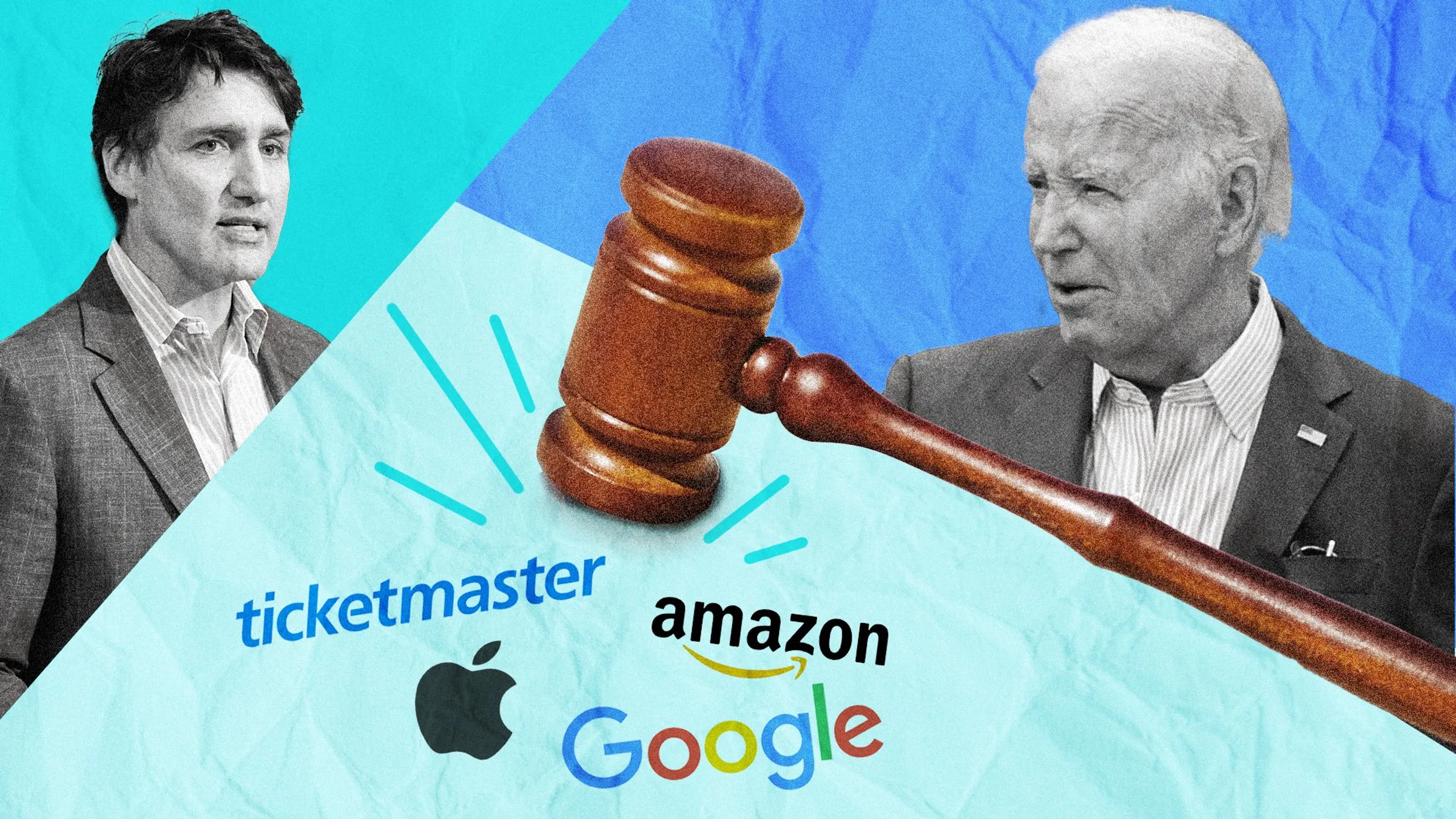
Bester points out that there’s an important distinction between legislation that empowers action against anti-competitive behavior and the actual enforcement of laws against monopolies. He notes that the US hasn’t actually passed more effective and modern anti-monopoly laws but adds that “Biden, and even presidents before Biden, have ratcheted up enforcement of existing laws.”

Algorithms are raising prices for everything. This must stop
The Globe & Mail
Vasiliki (Vass) B. raises concerns about the growing use of algorithmic pricing, where companies use software to monitor competitors and automatically adjust their own prices in response.
While marketed as tools for efficiency or competition, these algorithms can lead to higher prices across entire markets without any direct communication between companies. She argues that this form of digital price coordination amounts to a new kind of collusion that current Canadian laws are not equipped to handle. With prices already squeezing consumers, she calls for urgent regulatory action to address these invisible but powerful forces shaping what people pay.