
Keldon Bester
Keldon Bester
This is a custom heading element.
Keldon is the Executive Director of CAMP, and a Fellow at the Centre for International Governance Innovation (CIGI). Keldon has worked as a Special Advisor at the Competition Bureau, and as a Fellow at the Open Markets Institute.

Letters: Scammy
February 8, 2026Welcome to Letters from CAMP, a newsletter on anti-monopoly activity in Canada and abroad, brought to you by the Canadian Anti-Monopoly Project. In this instalment we have:
If you enjoy Letters, please considering sharing and supporting CAMP. Now let’s dive in.
Welcome to the World of ScamsIf you were online during last year’s election, you probably saw at least one ad featuring a slightly off-putting video of a political leader offering a fantastic new investment opportunity courtesy of the federal government. Those ads are the tip of the iceberg of the exploding problem of scams facilitated by the online advertising market. In 2024, over 36,000 Canadians reported losing money to online scams, to the tune of nearly $650 million. The effects of these scams are not limited to consumers, with legitimate advertisers suffering reputational harms from impersonation and financial losses when ads are placed on low quality websites or farmed for clicks by bots. In our new report, CAMP lays out some of the ways scammers exploit the online advertising market, how digital giants profit from the sale of scam ads, and how Canada’s government can step up to protect Canadian consumers and businesses from an increasingly predatory online advertising system. Whether its crypto scams, bogus investment schemes, or the evocatively named pig butchering, online scams are a monopoly problem. Tackling the issue means changing the incentives for the digital giants that dominate the online advertising market, turning blind eyes and reactive measures into proactive enforcement in defense of Canadians. The good news is that a global response is building. This week, U.S. senators introduced new anti-scam legislation, joining peers like Australia, the European Union, Singapore, and Taiwan in making an assertive defense in the interests of consumers and businesses. Each of these approaches focus on data protection, transparency, advertiser verification, and liability for companies who fail to do their due diligence to remove scams. Now it’s our turn. Canada needs to move on anti-scam legislation today, and CAMP has provided the blueprint. 📰 CAMP in the News 📰
Charting Big Tech’s Spending SpreeAfter a brief dip in 2023, mergers are back on the menu for Big Tech in 2025. This week, Digital Merger Watch, a global network of anti-monopoly of organization of which CAMP is a part of, released their 2025 Mergers and Acquisitions report. Mergers and acquisitions have long been an important part of big tech’s drive to consolidate its power globally and to gain footholds in new markets. That’s what makes Digital Merger Watch’s work of tracking and intervening in harmful mergers around the world so important. Unsurprisingly, the major trend in 2025 was AI, with 15 of 25 major Big Tech acquisitions occurring in the markets related to generative AI. But as enforcement scrutiny of acquisitions has ratcheted up, tech giants have adapted their playbook to evade regulators. In addition to the acquisition of emerging competitors, tech giants also employ strategic investments in the markets for the inputs that these companies depend on. By increasingly owning a stake in the infrastructure that supports new startups, these companies create an ecosystem where potential challengers are technologically and financially dependent on their competitors. The report also details the rise of acquihires, where a company simply hires away the top talent of an emerging threat, hollowing out their intellectual resources while avoiding triggering regulatory review. While in some cases the services of acquired firms are folded into the acquirer’s offerings, Digital Merger Watch found that in 20% of cases acquired companies discontinued services entirely. Unfortunately, the truism that if you can’t beat them, buy them is proving to apply to the current wave of technological development. The acquisitive reach of these companies spans the globe, and CAMP is glad to be part of an international effort to track and curb this power. As middle powers navigate the new geopolitical landscape of 2026, this kind of collaboration across borders will be key. 📚 What We’re Reading 📚
Appeal with ZealLast spring, a U.S. judge decided something obvious: Google has a monopoly in internet search. Then, the same judge did something less obvious: let them off the hook for it. The remedies hand down in the DOJ’s case against Google’s search monopoly were widely considered not up to snuff, relying too heavily on the hope that Google’s dominance was about to be disrupted by AI competitors like Perplexity and OpenAI. But just months later, Google’s share of the generative AI market has exploded and OpenAI is on the back foot as it aims to raise another massive funding round to keep itself afloat. At the time, CAMP was disappointed to see the DOJ frame this remedy decision as a win, but the mood at the department has changed. This week, the DOJ and several state attorneys general announced they are seeking to appeal the remedy decision. Likely on their list of demands is a structural remedy that would see the Chrome browser, an important source of customer data, spun off from the company. Structural remedies are important because they limit Google’s ability to leverage its dominance into emerging competitive markets. Google’s monopolies in search and online advertising have allowed it to commit to $185 billion of spending in the coming year to cement its dominance in the market for generative AI, a figure few rivals can match. While the market is fiercely competitive today, we risk a repeat of the pattern of tech domination we saw in the first two decades of the 2000s, this time without the scrappy upstarts. Putting it mildly, the Trump DOJ has been a mixed bag on antitrust, but between the Google search and Meta case there may be remaining room for optimism. If you have any monopoly tips or stories you'd like to share, drop us a line at hello@antimonopoly.ca
Follow CAMP on Twitter LinkedIn Instagram or Facebook |

Private assets, public risk
Published in The Globe and Mail
Ontario’s securities market regulator has faced pressure from Premier Doug Ford’s government to authorize a new class of mutual funds aimed at retail investors that can hold higher-risk private assets such as real estate. Featuring perspectives from CAMP fellow, Rachel Wasserman.

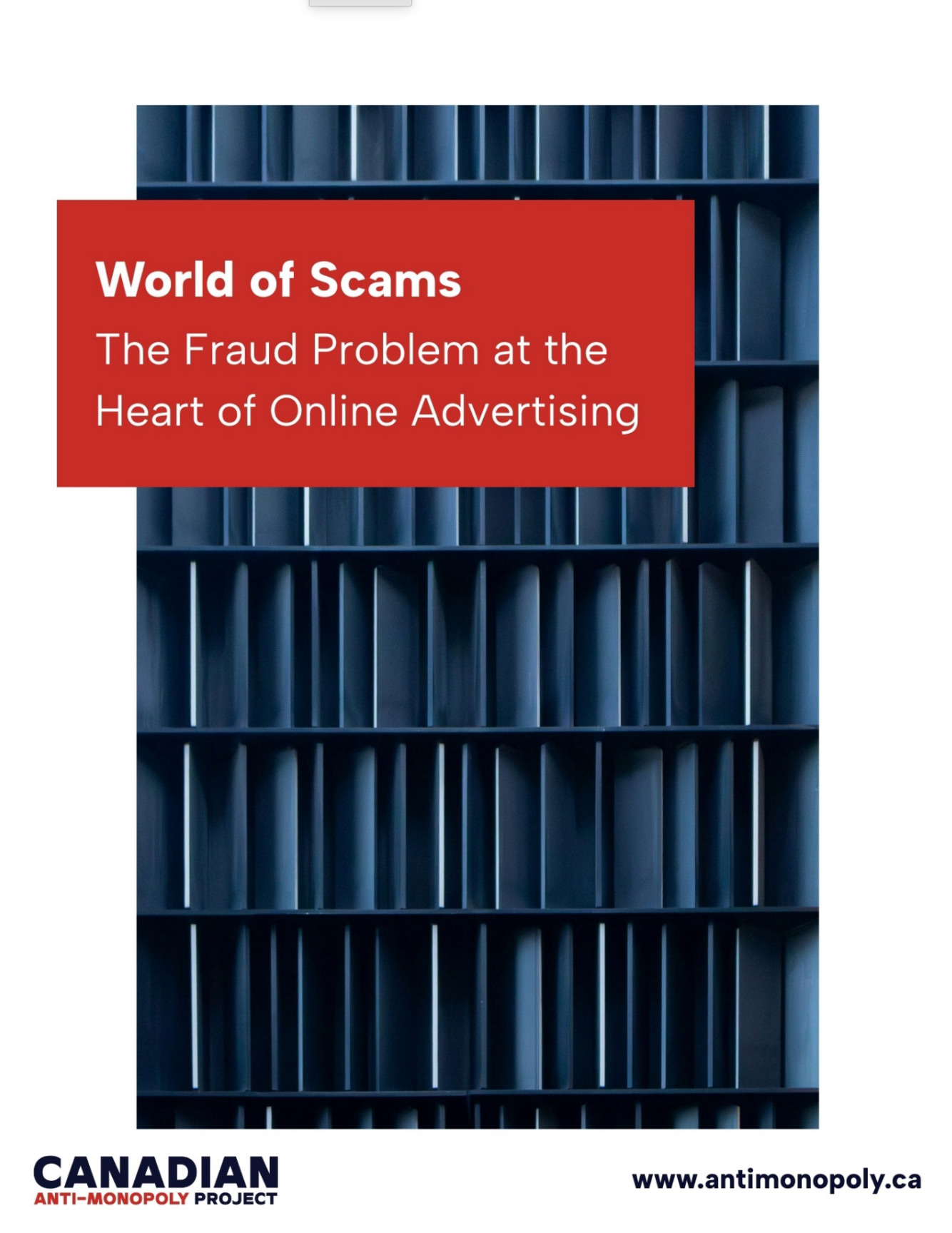
World of Scams: The Fraud Problem at the Heart of Online Advertising
The proliferation of online scams are a global problem with Canadian consequences. In recent years, scams ranging from pyramid schemes, sham investments, and long-running confidence games have fleeced Canadians to the tune of over $650 million. These costs balloon further when we consider ad fraud, the misrepresenting of low quality advertising supply, and its ability to cheat businesses out of their legitimate advertising dollars. Facilitating this tidal wave of scams is an oligopoly online advertising market that creates highly detailed profiles of consumers, obscures the identities of advertisers, and turns a blind eye to revenue earned through fraudulent ads.
In a new report, CAMP lays out the harms to consumers and businesses from this growing world of scams, successful regulatory interventions from peer jurisdictions, and what Canada can do to better protect our citizens. Stemming the tide of scams means changing the incentives that make their proliferation profitable. To set a course for safer internet for Canadian consumers and businesses, policymakers should:
- Strengthen data protection laws, restricting the creation, collection, and use of sensitive information for advertising purposes
- Require know-your-customer and advertiser verification and reporting, giving researchers and companies the tools to understand the market and keep competition fair
- Develop anti-scam regulations outlining the responsibilities of large advertising platforms, including transparency requirements, and obligations to prevent, detect, and remove fraudulent content
- Empower regulators the Office of the Privacy Commissioner and law enforcement agencies like the Competition Bureau to ensure compliance with anti-scam laws
Letters: Band-Aids
February 1, 2026Welcome to Letters from CAMP, a newsletter on anti-monopoly activity in Canada and abroad, brought to you by the Canadian Anti-Monopoly Project. In this instalment we have:
If you enjoy Letters, please considering sharing and supporting CAMP. Now let’s dive in.
Only Competition Policy Can Deliver Lasting Change to Canada’s Food SystemThis week, the Prime Minister announced a package of new measures to address rising food prices and food insecurity affecting Canadians across the country, with a headline expansion of the GST credit for lower-income Canadians. Support for those struggling is a welcome development, but the policies will do little to change the markets that produce the high prices Canadians are unhappy with. While the announcement included a commitment to “support the work” of the Competition Bureau, there was no detail on what that support entailed in the wake of recent cuts to the agency. One fan of the announcement? The CEO of Canada’s third largest grocery chain. The policy package is a reminder of the tension between policy changes that redistribute the spoils from markets and those that change how they are generated in the first place. An accurate knock against competition policy is that its benefits develop over time. More competition doesn’t bring down prices overnight and the path isn’t always linear, as Canadians have seen lately in wireless prices. But without changes to competition in underlying markets, we’ll find ourselves putting another band-aid on a persistent issue soon enough. Consolidation is at the heart of Canada’s food system, with powerful middlemen squeezing producers and consumers alike. We need to break these markets open and ensure monopolists share the burden of rising costs rather than passing them on. We also need to consider novel uses of existing policy tools in our food system. Canada’s supply management system gives us a say over key staples and could be used to steady or reduce rising prices. Both approaches would be departures from the status quo and provoke serious opposition, but this focus on markets is the only way we can achieve lasting change. You’ll never be able to cut a ribbon for more competition, but anti-monopoly investments today will pay off for generations. 📰 CAMP in the News 📰
Who Guides the GuidelinesThis week, CAMP submitted our response the Competition Bureau’s consultation on the proposed Anti-Competitive Conduct and Agreements Enforcement Guidelines. Other than a mouthful, what are enforcement guidelines? Enforcement guidelines are a public reference for businesses to understand how the Bureau will enforce the Competition Act. Not sure if something a business is doing is offside? Check the guidelines. When they work well, they reflect to the public the approach the Bureau will take to protecting and promoting competition. While the Bureau has made efforts to put the guidelines in plain English, they’re still deeply technical documents. But that’s what CAMP is here for. The good news? The guidelines describe a conduct-first approach that considers all the tools available for stopping anti-competitive conduct. They also suggest the Bureau will make greater use of interim or temporary orders that halt potentially problematic conduct while the agency investigates or litigates, speeding up relief for businesses and consumers. Finally, they detail how the agency can tackle serial acquisitions, a series of small acquisitions that can roll up markets behind our backs. While CAMP welcomes the Bureau’s new course, there’s still room for improvement. While the guidelines note that a company with a 30% market share could hold market power, they continue to consider a firm “dominant” only when it holds around 50% of a market. We know that a company with far less than half of a market can still engage in anti-competitive conduct. While there’s more to competition than market shares, in finalizing the guidelines the Bureau should be clear that problematic conduct well below the proposed threshold can still fall within its reach. 📚 What We’re Reading 📚
Searching for FairnessThis week, the U.K.’s Competition and Markets Authority (CMA) proposed measures that could change the balance of power between Google and online publishers as the giant increasingly incorporates AI into its search product. Following the CMA proposal, British publishers will be able to opt out of AI summaries and training, and Google chatbots will be obligated to clearly cite the sources for their results. Google will also be responsible for demonstrating to the CMA its rankings and summaries are fair, particularly important as sponsored content and AI summaries collide. The action is an important step to reclaim agency over how many Britons access information online. With the company responsible for 90% of internet searches in the UK, Google can set terms for publishers while lowering the quality of its results to drive ad revenues. As a ubiquitous internet middleman Google has subverted the business models for news media and changed the way that web pages are designed to serve the search giant’s interests. Users and businesses were forced to take the deal they were offered and for years regulators seemed were unwilling to intervene. This regulatory win was made possible because of recent moves by the British government to have a greater say over competition in digital markets. By designating Google search as having “strategic market status” (SMS) under their Digital Markets, Competition and Consumers Act, the CMA has a more direct path to rebalancing competition in the market. While the CMA must still consult on the proposal, the move has already spurred Google to proactively increase publisher control over AI search features. By creating a new avenue to recognize dominance and empower regulators to address it, the CMA has been able to generate results much faster than the typical multi-year antitrust case. If you have any monopoly tips or stories you'd like to share, drop us a line at hello@antimonopoly.ca
Follow CAMP on Twitter LinkedIn Instagram or Facebook |

Can AI clinical co-pilots break open Canada’s EMR ecosystem?
AI now has a credible path to disrupt Canada’s electronic medical record (EMR) markets. Not through wholesale replacement, but by working above and beside existing systems. Ambient scribes and second-screen clinical decision support (CDS) tools are already changing the lived experience of care without ripping out core infrastructure.
Read the full article here.